
Jeff Koons
“I'm a romantic at heart”
Interview of artist Jeff Koons by journalist Hans-Jürgen Jakobs, Munich, June 20, 2026. Published in Handelsblatt.
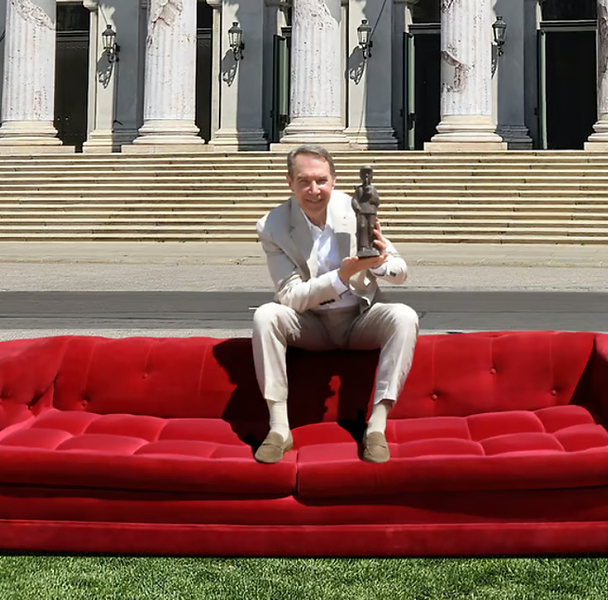
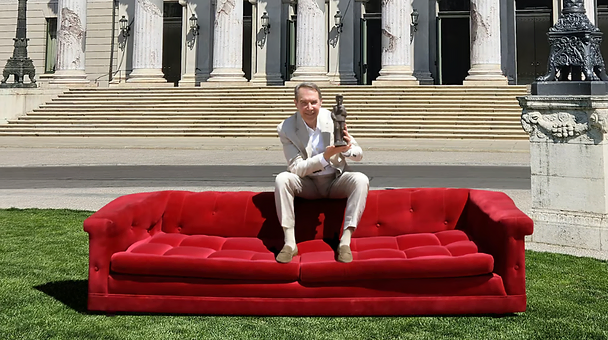
Munich, in front of the Bavarian State Opera. On a hot Saturday afternoon, a man poses on a red sofa. He is responsible for the temporary cladding on the theater's columns — which appear fragile and crumbling, symbolizing transience; that evening, he will speak at the opening of the opera festival. The man is Jeff Koons, 71, a renowned American artist — highly acclaimed and controversial. The photo session marks the beginning of a series featuring images of people on the red couch, which is set to appear at significant locations, such as in Ukraine. The concept was a success in the U.S. more than 40 years ago. Time for a longer conversation.
Jakobs: Mr. Koons, you lived in Munich for several years. Time and again, you enjoy returning to the Bavarian metropolis, for example to celebrate New Year's Eve. What is it that connects you so closely to Munich?
Koons: In the mid-1980s, I wanted to work with new materials — no longer with metal, bronze, or stainless steel, as I had done as recently as 1987 in Münster. There, I created a stainless steel sculpture based on the historical model of the Kiepenkerl…
Jakobs: …this figure of a traveling merchant was your breakthrough in Germany.
Koons: It was a piece about independence and self-reliance. But from then on, I preferred to work with wood or porcelain. Nowadays, anyone can own a small porcelain figurine; it has become accessible to all and is no longer the exclusive domain of kings or princes. As a base for my explorations, I chose a hotel in Munich and traveled through Bavaria and northern Italy. I visited many churches.

Jakobs: Among these early Bavarian experiences was apparently the discovery of the “Fairy-Tale King,” Ludwig II. He built castles, ran up huge debts, lost power, and chose to take his own life.
Koons: I've always been very drawn to his affinity for art and storytelling. His extravagance led to the devaluation of fame. Even when I was younger, I was confronted with aspects of German culture. My ancestors came from Germany or the Netherlands.
Jakobs: And what does that mean?
Koons: For example, appreciating glass orbs. I've always loved them. They reflect light in every direction and tell people where they currently are in the universe. That's what the interplay between body and mind is always about: Where do we stand right now? Ludwig II brought these glass orbs, which came from Venice, back into fashion.
Jakobs: Your goal has always been to use your own platform to devote yourself to the topic that matters most to you: the power of art. What can art really accomplish in the face of politicians, dictators, super-investors, or digital monopolists like Jeff Bezos, Mark Zuckerberg, or Elon Musk?
Koons: I like the American philosopher John Dewey, who was a strong advocate for the democratization of all areas of life as well as for an educational approach based on “learning by doing.” In his book Art as Experience, he writes about true communication. In its simplest form, it is a single-celled organism that is influenced by its environment. As a result, it changes, rewriting its DNA. This, in turn, has an effect on the environment. This back-and-forth, this interaction — that is culture. Everything we see represents culture, from the asphalt on the street to an ornamental plant. It's not about an elite or a hierarchy that renders us powerless and leads to divisions.
Jakobs: In this sphere you describe, there are specific actors in culture or the art market. They organize and commercialize the interactions they have outlined.
Koons: People in the art world believe they are very open when it comes to experiences. But this is not a common life experience. All I'm trying to do is share my personal story with art with the general public. My cultural background. My personal journey of discovering who I am in this world. And my ability to move forward from this point. The moment you accept yourself, you can also accept everything else and everyone else. Apart from interactions with other people, nothing else really matters. Every element of unpredictability brings meaning.
Jakobs: More than 60 years ago, Martin Luther King declared, “I have a dream.” Do you — as one of the world's most famous and highest-paid artists — also have such a dream?
Koons: I would like to reach a higher level of enlightenment. Or to have the ability to complete more works and truly make full use of my potential. For me, there are no excuses for not performing at the highest level.
Jakobs: So you're dissatisfied with yourself?
Koons: It's my dream to be free of fear in any regard and to maintain a high level of consciousness. Every day, I hope to get faster at it.
Jakobs: Nothing could be simpler: hiring more staff at your studio could help. Or you could try out different materials and technologies.
Koons: I'm currently working on reducing my environmental footprint. I got into art because I always wanted to be part of the group. As a young artist, I talked with friends and artists of my generation about our visions. Looking back, the avant-garde has always fascinated me — that group of independent artists who, starting in the late 19th century, fundamentally transformed the art world.
Jakobs: You mean Pablo Picasso, Henri Rousseau, Georges Braque, André Breton, and others who were based in Paris.
Koons: And they quickly gained international recognition. The U.S. was fortunate that people like Marcel Duchamp, Francis Picabia, and Man Ray came to the country. That had a significant influence on American art. This group of avant-garde artists formed a cohesive unit; they believed in themselves as individuals and in their ability to change their lives and the world around them. That quickly made them very human.

Jakobs: What is the reason you are able to successfully represent culture in a certain way today?
Koons: Because I've always gone “all-in,” despite all the limitations and obstacles. I've always believed in the power of art, in its ability to unite all human disciplines — everything that constitutes dialogue: philosophy, psychology, sociology, aesthetics, theology, physics, statics. Much of this is embedded in my paintings and objects. I merely design the transponders that stimulate the viewers.
Jakobs: Do you also have dreams of a world with less aggression, fewer wars, and fewer conflicts?
Koons: I have eight children and three grandchildren. For that reason alone, I'm very interested in the future. I'm generally optimistic. Humanity has been around for quite some time. We have fascinating tools at our disposal and access to so much knowledge — far more than ever before. We just have to use them properly. Of course, I'm aware of all these difficulties. But I'm also aware that, thanks to all these technologies, I myself am better educated. I'm grateful for everything we have, for example, artificial intelligence. I'm also aware of how I lived in the last century — reflecting on life, love, poetry, and how people live together. At heart, I'm a romantic and hope that we can use all these technologies for the benefit of humanity.
Jakobs: You even had a work of art, “Moon Phases,” consisting of 125 small stainless-steel sculptures, which was transported to the Moon by Elon Musk's SpaceX.
Koons: That's why I'm very aware of many aspects of today's space exploration — and of the responsibility we have toward our Earth. The distance from Earth does not mean that we can simply brush aside our earthly problems. We must continue to develop our awareness of how people experience life.
Jakobs: With your optimism, you are the polar opposite of the equally well-known British artist Damien Hirst, whose works mostly deal with the darkness of the world and the fear of death.
Koons: He is a great artist; I have always admired his work. When we think of an ideal world, an Arcadia, we know that alongside immense beauty and pleasure, there is also death. My inflatable object “Balloon Dog” has a skin, a membrane. That is the interface with the outside world. Everything is reflected; it's a kind of dialogue. Inside the “Balloon Dog,” however, you can sense the essence of the past, including the dark moments. A work of art like this is always both: a celebration of life and, at the same time, a reference to history, coupled with the hope that humanity will overcome its difficult circumstances.

Jakobs: AI is a technological revolution that challenges people. What makes the optimist Jeff Koons so certain that in the end, the benefits will outweigh the associated risks?
Koons: Of course I have concerns. Technology is evolving so rapidly. And there are terms in computer science, such as “neural networks,” which mimic the human brain, that really make you sit up and take notice. That's a different dynamic. But I remain an optimist.
Jakobs: Do you work with AI agents yourself?
Koons: No. But I use AI as a tool for working with materials. I use it to test different options. Look, the world around us is full of AI. It's being used everywhere to create surfaces and products. That's the reality. But I don't tell the AI program: “Hey, I'm living in the year 2026 and want to create a work of art that has something very important to say to the world.” I'm not interested in that sort of thing. What's truly fresh and new lies deep within us as human beings, not in a piece of software. That's what matters. What inspires me, what motivates me to live in the present? How do I take advantage of that? That is also something very old.
Jakobs: Which artists have particularly inspired you?
Koons: When I was young, Salvador Dalí. When I was 19, I called the New York hotel where he was staying and asked to be put through to him. He arranged to meet me that Saturday at twelve o'clock in the lobby and emerged from the elevator at exactly that moment, with his twirled mustache, a diamond-studded tie pin, and a huge buffalo hide. We arranged to meet at a gallery where he was exhibiting and where he wanted to meet a French journalist — who turned out to be Amanda Lear, the well-known artist and TV host, a former model. And she was Dalí's muse for many years. I was then allowed to take a photo of him in front of his large-scale painting “Royal Tiger.” At that moment, I thought I could make art a way of life. It became clear to me what it means to be an artist. I have never forgotten Dalí's generosity.
Jakobs: It sounds like a dream come true. Could you ever have imagined back then that you'd have a career like this?
Koons: The word “career” is associated with money these days. We were never particularly interested in that during my youth. Back in the 1970s in New York, we looked up to artists like Dalí, Duchamp, Jasper Johns, Robert Rauschenberg, or Roy Lichtenstein. They were figures who focused entirely on their work, without any side jobs. That was their life. We admired them for the fact that art was the anchor in their lives.
Jakobs: That seems nostalgic when you look at the current art market with its high prices.
Koons: The concept of money came into the art world at a later stage. It probably means more to younger artists than to artists like me. We didn't operate out of such desires, but because we believed wholeheartedly in art.
Jakobs: You talk a lot about leadership. Would you say that you are a leader in the art world?
Koons: I can't say. My paternal grandfather was a bus and streetcar driver. My other grandfather was the city treasurer in the town of York, Pennsylvania, where I grew up. He was also a merchant and ran a grocery store, among other things. And all my uncles and aunts were merchants as well. My father owned a furniture store and was an interior designer. So I grew up in a family where we took joy in communicating with people.
Jakobs: What came of that?
Koons: That kind of behavior became second nature to me. I learned to influence my own feelings by developing my own iconography in art. I was able to control my attractiveness, as well as the powers of my body and my mind. And at some point, I discovered that I could also influence the feelings and experiences of other people.
Jakobs: You describe how you became popular.
Koons: I've never done anything just to be loved. I am loved by my wife Justine and my family. My plan was rather to accept myself as a person. When you do that, you can accept everything in the world out there. This process generates a great power. You automatically feel a sense of transcendence.
Jakobs: You feel connected to something greater, beyond the boundaries of the everyday?
Koons: You want to share this feeling with others. I never do things that I assume people will like. My only hope is to communicate with them in some way so that they sense a substance for their own potential. It's not about me, not about my work — it's about them. It's about intellectual benefit. So I see myself as a servant, not as a boss. My life has completely changed since those days in Pennsylvania. Today I'm sitting here talking to you about the impact of art.
Jakobs: Part of that is that your sculpture “Rabbit” was auctioned a few years ago for the record sum of 91 million dollars. What does that fact mean to you?
Koons: That's not relevant to me. Markets simply absorb a lot of information. What's relevant to me, as I said, is being in dialogue with others and the world. Auctions don't express that.
Jakobs: Do headlines like the one in the French business magazine “Challenges” — which ran the headline: “Why Jeff Koons, the world's most creditworthy artist, is so despised” — annoy you?
Koons: No one wants to hear something like that. I learned early on that you can't please everyone. Still, when I read something like that, I feel like I've failed — because I do want to reach everyone. I believe my intentions are good. That's why I speak so openly about these issues. The only thing I can do is help people open up and understand what makes them who they are, what is perfect in their own eyes. That eliminates a lot of hatred and a lot of opposition.
Jakobs: But such harsh criticism causes pain.
Koons: The artists I respect have had to deal with similar challenges. Even the widely admired Pablo Picasso was criticized, including for his later works, which I greatly appreciate. There are simply positive and negative forces; there's always a yin and a yang.
Jakobs: You're also described as an ambassador for America. Is that accurate?
Koons: I like to think of myself as one of many ambassadors for America. It's a great feeling to sit together with a group of artist friends, exhibit in a city, and ultimately have an international presence. And to have worked in Germany with artists like Albert Oehlen, Markus Kippenberger, Günther Förg, or Sigmar Polke. I feel fortunate for all the education and opportunities I've had. Also for my encounters with nature and tradition, for example in Bavaria. All the schnitzel and pretzels. (Laughs)
Jakobs: What are the conditions that allow works of art like “Balloon Dog” or “Rabbit” to become icons?
Koons: In 1988–89, I had my “Banality” show in New York. People told me it was the most successful show since Roy Lichtenstein's in 1963. A journalist asked me if I wasn't afraid that success might elude me. I found that question strange. I thought about what defines my work. My conclusion was that I can only follow my intuition and my interests. We have nothing other than our interests. It's easy to notice the abundance of available information. This connects you all the more strongly to a universal vocabulary.
Jakobs: Doesn't your collaboration with commercial partners like Stella McCartney, Google, Evian, Lexon, or BMW — who use their icons and ideas — also serve this purpose?
Koons: I like being open to such opportunities. It usually brings me new insights every time I go into the studio to work on such a project — which is far removed from my actual work — and develop concepts. For example, when I'm working on an “art car,” I might gain new insights into materials science. Or it stimulates me to find the best solutions using AI.
Jakobs: You're here in Munich, among other things, for a photo shoot centered around the famous “red sofa,” created by photographer Kevin Clarke, who traveled with it throughout America and the world for many years. What does a project like this mean to you?
Koons: I am a close friend of Kevin Clarke. Many years ago, I took part in his “Red Couch” series. A project like that has a huge impact. It means a lot to me to experience the update to this project here in Munich. It's wonderful in life to keep friendships alive. Early on, Kevin discussed with me and others what art means to our generation.
Jakobs: If we were to ask passersby on the streets of Munich about Jeff Koons, what do you think their answer would be?
Koons: Probably the first thing they'd say would be, “Jeff Who?”
Jakobs: And what about those who are more interested in art?
Koons: If you're lucky enough to find these people, they might talk about one or two images that have made their way into the mass market more than others — like “Balloon Dog” or “Rabbit.” Maybe also about my little dogs, the “Puppies,” or a flower sculpture. Things like that.
Jakobs: What, actually, remains as a future challenge for someone who's already managed to place his artworks on the moon?
Koons: There are still projects inside me that haven't yet come to the surface. I'm working on them. I want to seize the moment when I recognize them, and in this way feel that I'm alive. I want to embrace every moment that we're here on Earth, fearlessly and openly. All we can do is appeal to people: Take action! Take the first step!
Jakobs: You could also open your own museum, featuring your own works and many others. After all, you're also a major art collector.
Koons: My next steps will be focused solely on creating my own artwork.
Jakobs: Mr. Koons, thank you very much for the interview.

“I'm a romantic at heart.”
Take action! Take the first step!
U.S. art star on romance, culture and the power of art — on the original 1979 Red Couch in Munich.
Jeff Koons (born 1955) is one of the most acclaimed and controversial American artists of his generation. Known for works such as “Balloon Dog,” “Rabbit,” and the “Banality” series, his practice explores dialogue, acceptance, and the power of art to connect people. His stainless-steel “Kiepenkerl” (1987, Münster) marked his breakthrough in Germany; in 2026 he returned to Munich to clad the columns of the Bavarian State Opera for the opening of the Munich Opera Festival — and to sit, once again, on Kevin Clarke's original 1979 Red Couch.
Kevin Clarke
© Kevin Clarke
Munich, Germany
June 20, 2026